

Friction blister treatment and prevention in Esperance
Friction blisters on the feet are the most common injury in runners, walkers & hikers, and netball players. People with foot blisters are also more likely to develop other injuries, as they change the way they walk to protect a sore spot.
For such a common injury, it's surprising that most people misunderstand what causes friction blisters.
What really causes friction blisters?
It's not heat, moisture and friction
The usual explanation goes like this: your foot gets hot, it sweats, and the moisture makes your sock or shoe rub your skin. It sounds sensible, but it's not what happens.
Here's what really causes friction blisters. Do this with me:
Place a fingertip on the back of your opposite hand. Now rub it back and forth. This is what most people think causes blisters... rubbing.
Now do the same, but this time, keep your fingertip stuck to the same piece of skin on the back of your hand. Move it back and forth as far as it can go, but keep it stuck to that same bit of skin. This looks a lot like rubbing, doesn't it? But if you look closely, nothing is rubbing across the skin because you've got your fingertip stuck to the same piece of skin. What is happening though is all of the soft tissue on the back of your hand is stretching and distorting. This is called shear, and this is what causes blisters.
Surprising, right?
Why Rebecca knows blisters
Rebecca has blister-prone feet herself, which is how her special interest in blisters began. Over many years she has helped endurance athletes, hikers and ultramarathon runners prevent and manage blisters. She founded the Blister Prevention website and BlisterPod brand. And with US podiatrist Dr Douglas Richie, she co-authored two papers published in the Journal of Athletic Training in 2024:
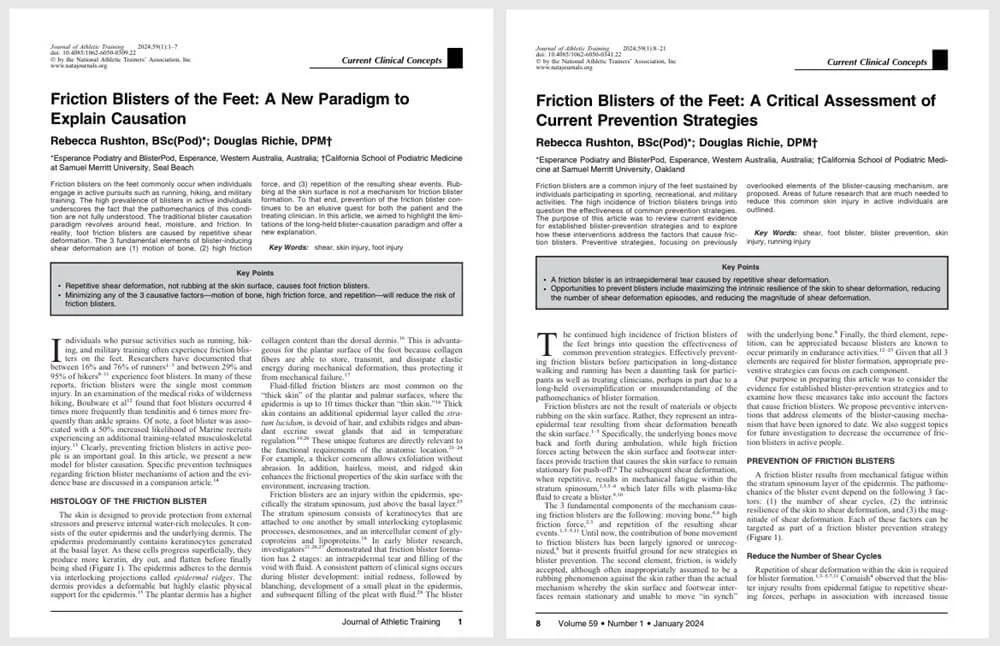
Rebecca Rushton and Doug Richie’s friction blister papers from 2024
Treating a friction blister
The blister treatment equation
First aid + blister prevention = meaningful blister treatment
First aid is an important part of treating a blister. It prevents infection and looks after the weakened skin. It's the antiseptic and the dressing.
But the dressing doesn't stop the shear. Shear is still happening within the skin you've just covered with the dressing. This is why blisters continue to be painful and get worse in spite of covering them up.
If you want to make your blister feel better and stop it from getting worse as you pull your shoes back on and keep going, you'll need to implement the prevention... as well as the first aid.
Think of it like sunburn. If you get burnt, you might apply some aloe vera to soothes your skin (first aid). But if you need to get back out in the sun, you'll need to slip, slop, slap (prevention) if you don't want to get more sunburnt.
Which dressing?
The right dressing depends on the integrity of your blister roof.
Roof intact: a fluid-filled bubble with the blister roof skin over it unbroken. First aid: an island dressing (band-aid).
Roof torn: the roof is broken and the fluid is leaking out, but the skin of the roof is still partly covering the blister. First aid: antiseptic and an island dressing (band-aid).
Deroofed: the roof is completely gone, leaving a patch of raw, weepy skin. First aid: antiseptic and either an island dressing (band-aid) or a hydrocolloid dressing (such as Compeed).
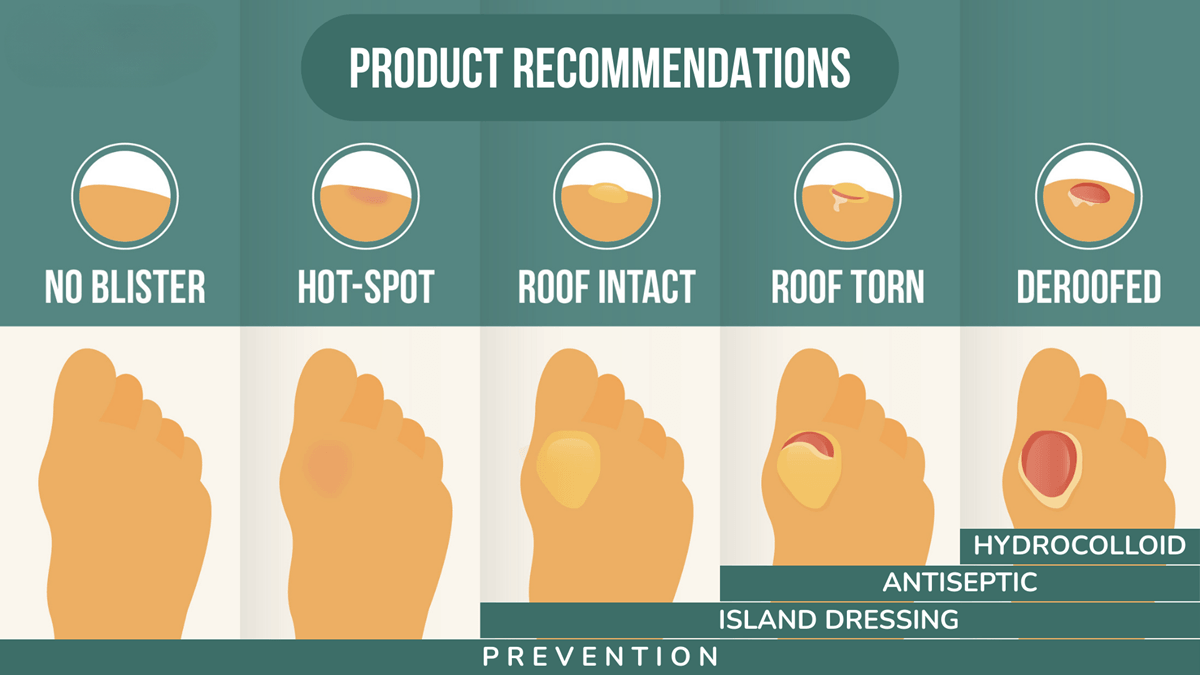
5 friction blister stages. Source: www.blister-prevention.com
Preventing friction blisters
To prevent something, you have to stop its cause. With blisters, that means reducing shear. Rebecca and Dr Richie's second paper reviewed the evidence for common blister prevention strategies and how well each one targets shear. From tapes to socks and shoe fit, to lubricants, powders and ENGO Patches; from donut pads, moleskin and insoles, to toe-props, gel toe protectors and orthotics.
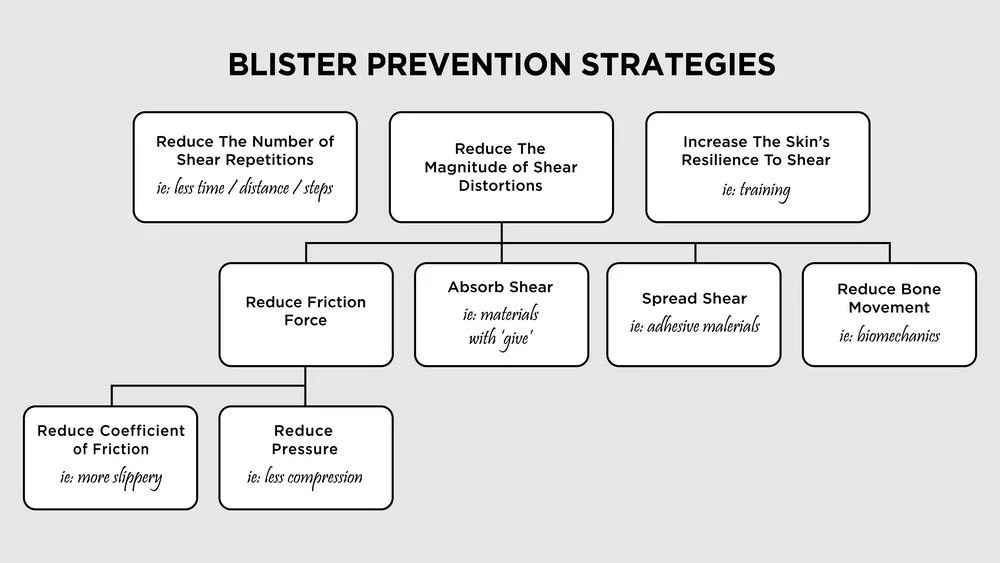
The mechanisms for the prevention of friction blisters on the feet. Source: www.blister-prevention.com
Tips to get you in the right headspace for blister management success
Tip 1: Start with where on your foot
Don't ask "What's the best blister prevention for hiking, running, football or whatever the activity?" Ask "What's the best blister prevention for this specific part of my foot (back of heel, tip of toe, under the ball of my foot)?" The best option depends on where the blister forms, not what sport or activity you're involved in.
Tip 2: Predict your blisters
Blisters are more predictable than you think:
Your blister history is your most valuable information. The blister you're most likely to get is the one you've had before. Expect it, and have the right prevention in place before you start.
Callus marks your likely blister spots. Callus and blisters are caused by the same thing: shear. Callus is the long-term response, and a blister is the short-term one. Expect blisters anywhere you have callus.
Tip 3: Start with your best prevention
Put your best prevention in place from the start, not the thing that sometimes helps, helps a little, or hasn't worked before. Don't wait until there's damage before pulling out the big guns.
Tip 4: Prepare before you set off
The more prevention you have in place before you start, the less you need to carry with you.
Tip 5: Don't wait for the hot-spot
The hot-spot feeling is often subtle and brief, and easy to miss or ignore. If you feel the sting, you're already too late, as a blister is on its way. Be proactive, not reactive.
Tip 6: Stretch your calves
Tight calves are linked to many foot problems, including blisters on the ball of the foot. Technique matters: turn your toes in slightly, keep your knee locked straight and your heel on the ground. Stretch your calves at each rest stop on a long walk.
Six friction blister myths
Myth 1: Friction blisters are caused by rubbing. They're caused by shear under the skin.
Myth 2: Blisters are inevitable. Blisters are highly predictable, and very preventable.
Myth 3: Callus protects you from blisters. Callus shows where you'll get a blister.
Myth 4: Taking action at the hot-spot stage is the best approach. This is reactive and prone to failure. Be proactive instead.
Myth 5: Tape (or Compeed) is the best way to stop blisters. Tape and Compeed spread shear out, but they're far from eliminating it.
Myth 6: Compeed is the best thing to use for any blister. Only for deroofed blisters.
Get your Blister Plan
If you keep getting blisters, whether hiking, running, playing netball or football, or at work, book an appointment with Rebecca. She'll look at where your blisters happen, your blister and callus history, your footwear and how you move, and put together a personalised Blister Plan: the right prevention for each blister site, and what to do if one starts.
Bring your shoes, socks and anything you've tried before.
No referral is needed. Call (08) 9072 1514 or visit us at Suite B, 116 Dempster Street, Esperance.